Three Things Nobody Told Me About My Knees Until I Was 62
I'd taken glucosamine for eleven years. Every one of these three facts is in a first-year anatomy textbook. Not one of them was ever said to me out loud.
I want to be careful here, because I'm not a doctor and this isn't a miracle story.
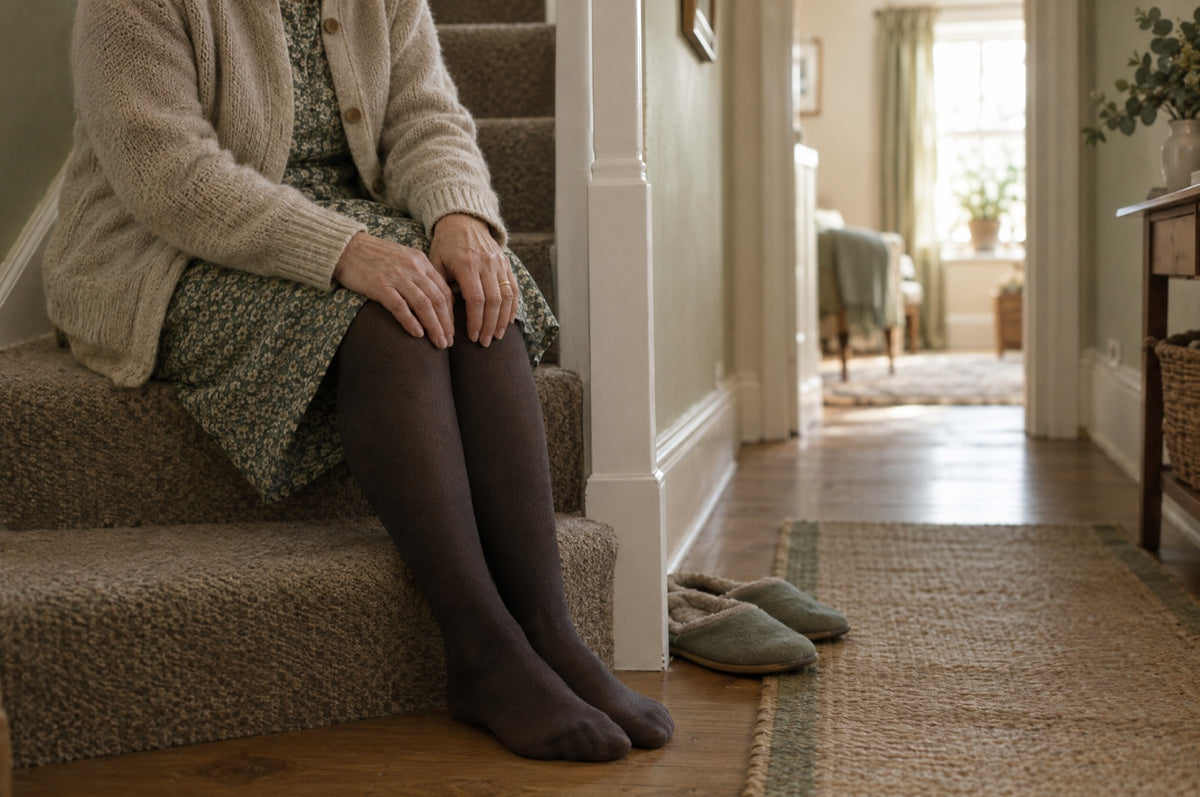
I'm 62. I taught primary school for twenty-nine years. Somewhere in my early fifties the stairs stopped being free, and like most people I did the sensible obvious thing: I bought glucosamine, took it every morning with my tea, and waited.
Eleven years. A bottle always in the cupboard. A strip of ibuprofen in every coat I own.
What finally changed things wasn't a new product. It was three facts about the tissue itself — told to me in about four minutes by a physiotherapist who wasn't selling anything.
Each one is ordinary science. Together they explain why eleven years of doing the right thing did nothing at all.
The part that's wearing out cannot feel pain.

Cartilage has no nerve supply. None. It is physically incapable of hurting.
I had to have that said twice before it landed. The tissue everybody calls “the problem” has no way of telling you it's in trouble.
So what had I been feeling every morning for eleven years?
Everything around it. As the cushion thins, the bone underneath takes load it was never shaped for. Bone has nerves. It responds — swelling inside the marrow, small fluid-filled cysts, inflammation in the lining of the joint. That is the ache. That is what wakes you on the stairs.
Which means the pain is not the wear. The pain is the reaction to the wear, arriving late, from a different tissue.
It also explains the thing that had baffled me for years — why my worse-looking knee was the one that hurt less, and why some mornings were fine and some weren't, with no pattern I could find.
If the pain is the bone reacting rather than the cartilage complaining, then chasing the pain and feeding the cushion are two completely different jobs. I had spent eleven years doing neither properly — muting the first and assuming I was doing the second.
It has no blood supply either. So nothing you swallow arrives the usual way.

This is the one that made me put my cup down.
Cartilage has no blood running to it. It cannot pull nutrients out of your bloodstream the way muscle or skin does. It is a sealed cushion between two bones.
It feeds a completely different way: it drinks the fluid inside the joint, like a sponge. That fluid is the only delivery route there is.
So when I swallowed a capsule every morning for eleven years, it dissolved, it entered my blood, and then it needed to do a second thing — cross out of the blood into the joint fluid. Most of what I took never did. It circulated, and it left.
The physiotherapist put it in one sentence and I've not forgotten it since:
“You didn't fail the supplement. The supplement never made the jump.”
Eleven years of blaming winter, my weight, my age, being on my feet all day. The pills weren't weak. They were arriving in the wrong room.
It only eats when you move. Which is why the advice I was given was backwards.

A sponge sitting in liquid doesn't absorb much. A sponge you squeeze does.
Cartilage is the same. Every step compresses it, pushes the old fluid out, and lets fresh fluid draw back in as the load releases. Movement is the pump. Without it, the delivery route barely runs.
Now hold that next to what I'd been told for a decade, by well-meaning people: take it easy, protect the knee, don't overdo the walking.
Here is what the research actually shows. Recreational runners have roughly three times lower rates of knee and hip osteoarthritis than people who don't run. Competitive runners, lower still. Running appears to thicken knee cartilage rather than wear it away.
I'm not telling you to go running. I'm 62 and I have no intention of it.
I'm telling you that the instruction to sit still was switching off the only pump the tissue has — and I followed it carefully for years, believing I was being sensible.
No nerves, so it can't tell you. No blood, so you can't feed it the usual way. And it only eats when you move — which is exactly what I'd been told to stop doing.
The thing I'd accepted as permanent is being argued about again.

The reason nobody had ever bothered to explain any of the above to me, I think, is that it didn't seem to matter. Cartilage wears out, cartilage doesn't grow back, manage the pain, come back in six months.
That last part is being actively reconsidered. National Geographic ran it plainly this year: doctors have long said cartilage can't regenerate, and they're now rethinking that. Researchers at Stanford Medicine published work on reversing cartilage loss in aging joints; cartilage taken from knee replacement surgery produced new tissue in the laboratory.
Now — I want to be completely straight with you about what that is and isn't.
That is laboratory and early-stage research. It is not a supplement, it is not on a shelf, and nothing you can buy today, including the product I take, does what those researchers did. Anybody who tells you otherwise is lying to you.
What it changed for me was smaller and more useful than that.
“It can't come back” is the belief that made me stop trying to feed the joint at all. I wasn't managing it. I was writing it off, one flight of stairs at a time, and calling that being realistic.
Three facts, one conclusion. The cushion can't warn you, can't be fed through the blood, and only feeds when you move.
So a supplement has exactly one job: be present in the joint fluid at the moment you take a step. Everything else — the brand, the milligrams on the front, how sensible you're being — is downstream of that.
Mine never got there. For eleven years.
Most of it doesn't even get into you
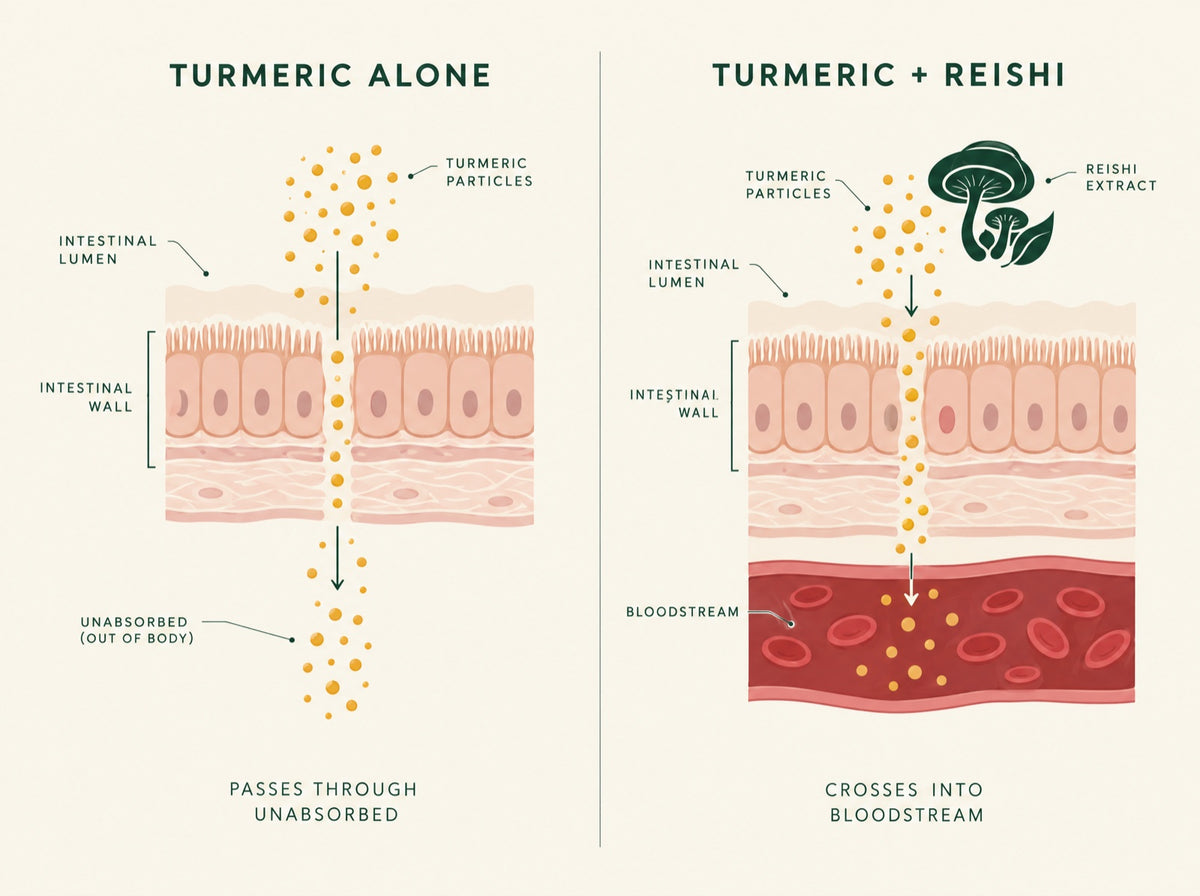
Turmeric is the comfort compound in nearly every joint formula on the shelf. On its own your body barely absorbs it — most passes straight through, unused.
So before the delivery problem, there's an absorption problem. Two walls, not one.
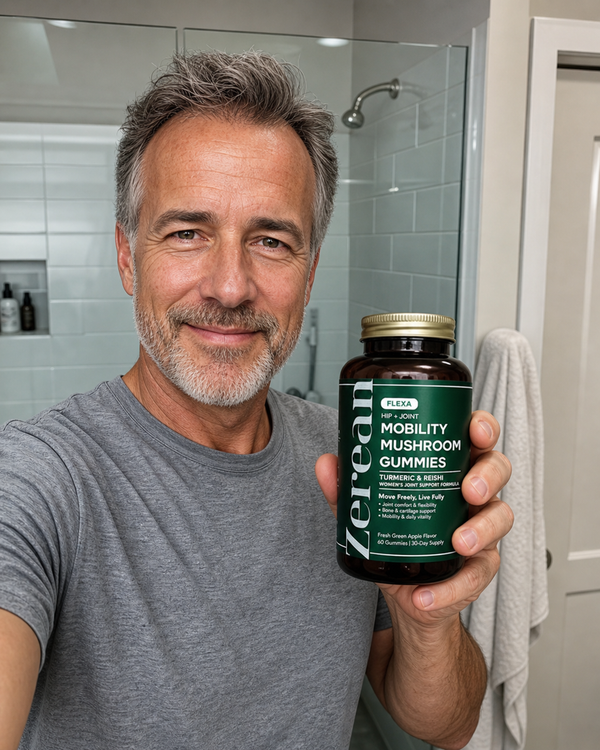
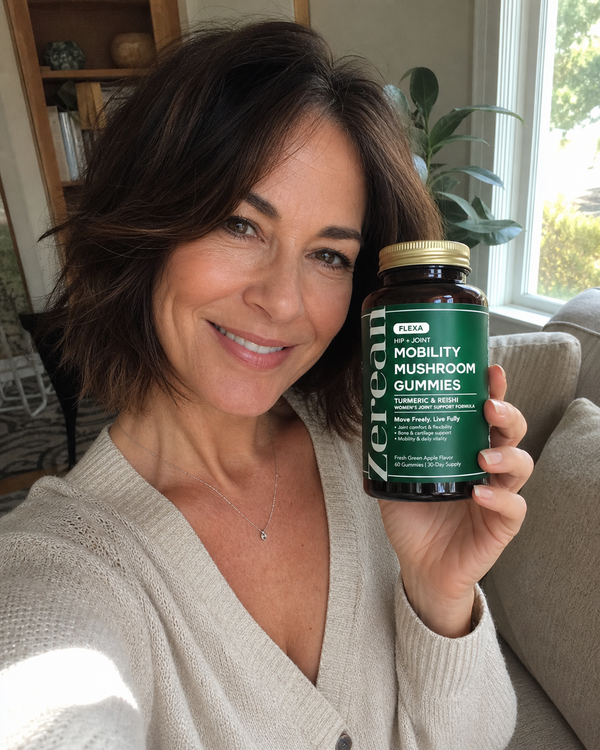
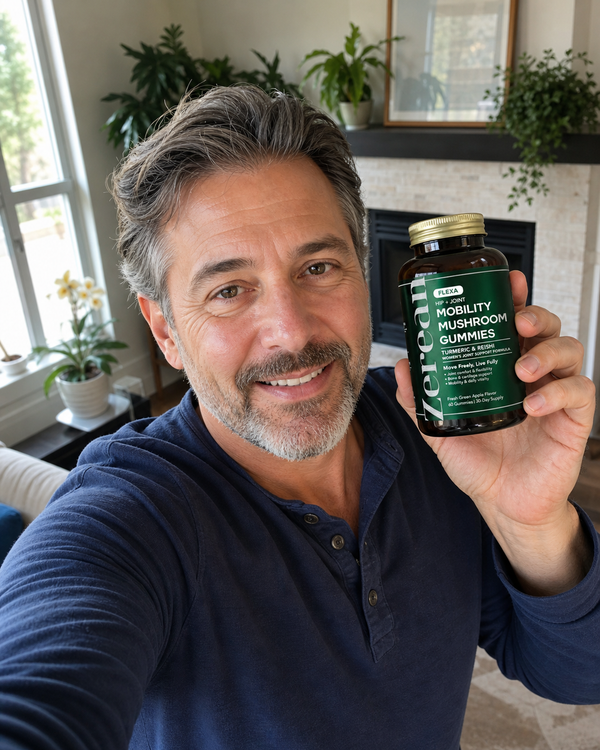
Flexa pairs turmeric with Reishi, a functional mushroom shown to help the body take in up to 99× more of it than standard turmeric.*
And what does get in has to make the jump
Clearing the gut is not the same as reaching the joint. Cartilage sits downstream of synovial fluid, not of a vein.
That's why dose and molecule size matter, and why a few hundred milligrams pressed into a hard capsule with no absorption partner was never going to reach the surface that's actually worn down.
Not into your bloodstream. Into the joint fluid, at the wear surface — pumped deeper with every step you take.
What's actually in it, and why each thing is there
I checked this against the trials before I ordered, because by that point I was checking everything.
| Ingredient | Per daily serving | Why it's in there |
|---|---|---|
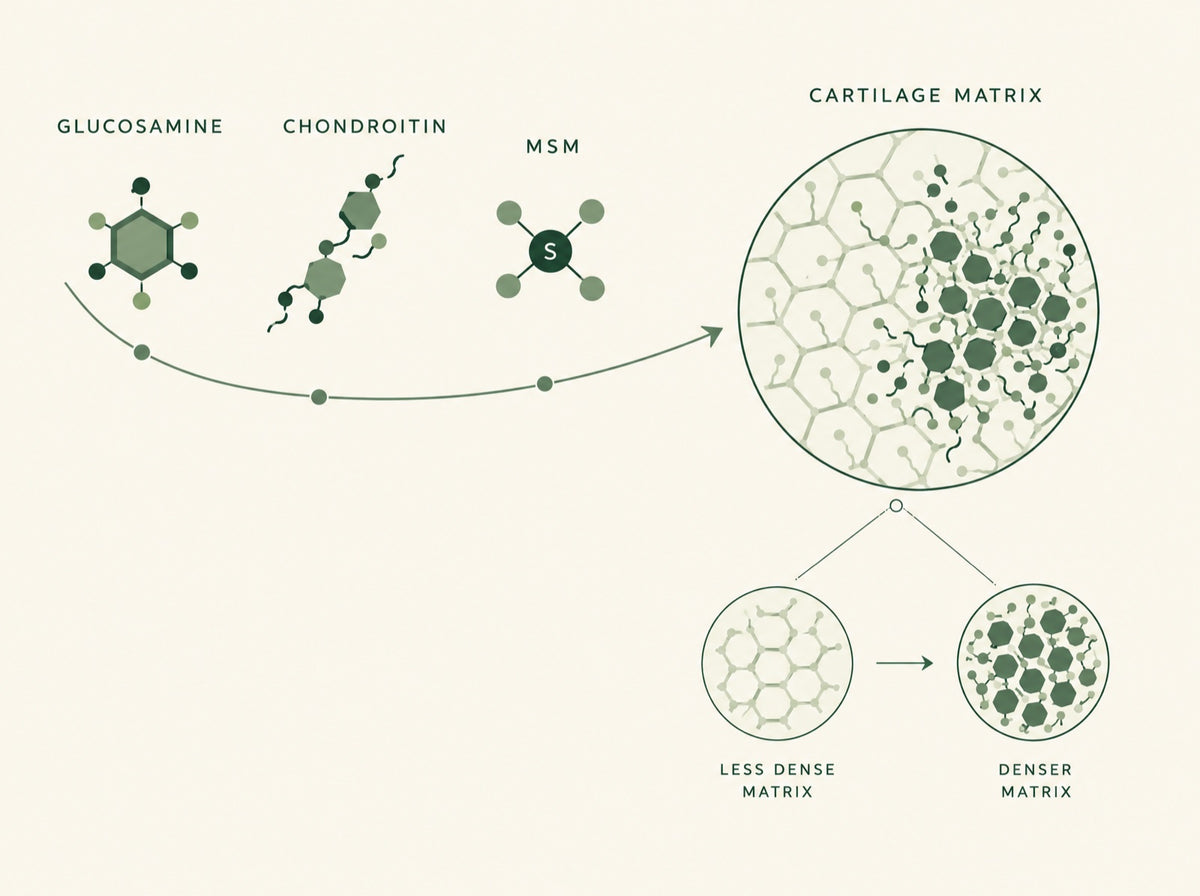
| Glucosamine | 1,500 mg | A building block of cartilage. This is the dose used in the NIH-funded GAIT trial and referenced in NHS clinical guidance — not a token amount. |
| Chondroitin | 800 mg | Paired with glucosamine in the trials; helps cartilage hold water, which is what makes a cushion a cushion. |
| MSM | 1,000 mg | A sulphur compound with its own placebo-controlled knee trials. |
| Turmeric | 200 mg | The comfort compound — reviewed across 16 trials and 1,810 adults. |
| Reishi | included | The absorption partner. This is the one most formulas leave out, and the reason the rest can get in at all. |
| Vitamin D3 | included | Contributes to normal muscle function and the maintenance of normal bones. |
| Calcium | included | Contributes to the maintenance of normal bones — the tissue doing the complaining in Fact One. |
They ran it against a prescription drug. It held.
This is the part that ended my scepticism, and it's the reason I'm comfortable writing any of this down.
Glucosamine and chondroitin were tested in GAIT — NIH-funded, 1,583 people, at 1,500mg of glucosamine a day.
Then MOVES: 606 people, the same combination, head to head against celecoxib, a prescription anti-inflammatory, over six months. Comparable results.
That is not a wellness claim. That's a supplement combination run against a prescription drug in a randomised trial and not losing.
The studies referenced above
What actually happened, week by week
Nobody gives you the timeline, so you quit in week three thinking it failed. Here's mine, honestly.
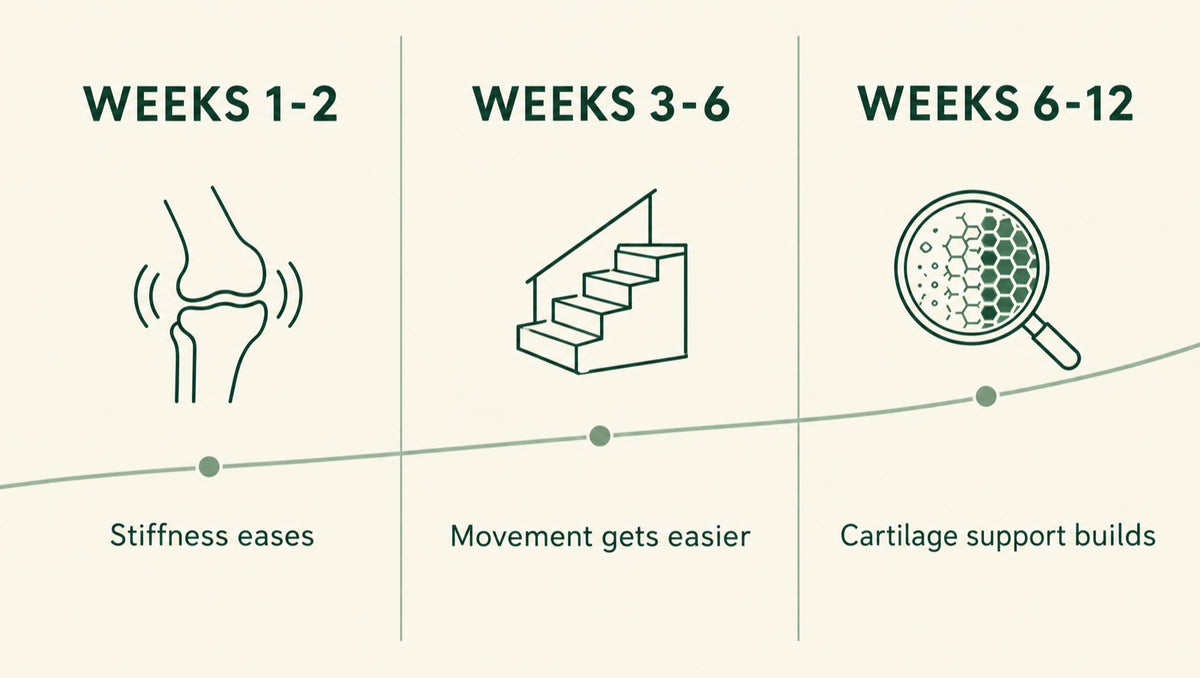
Weeks 1–2. Not pain relief. Looseness. I noticed I wasn't bracing before I stood up.
Weeks 3–6. The stairs stopped being a decision. This is where I stopped mentally logging it.
Weeks 6–12. The stretch that matters. Raw material, delivered daily, doing quiet work.
Week 11. A whole Sunday in the garden beds. I didn't think about it once.
Give it the twelve weeks. Judging it at three is how I wasted eleven years.
Real users, real results
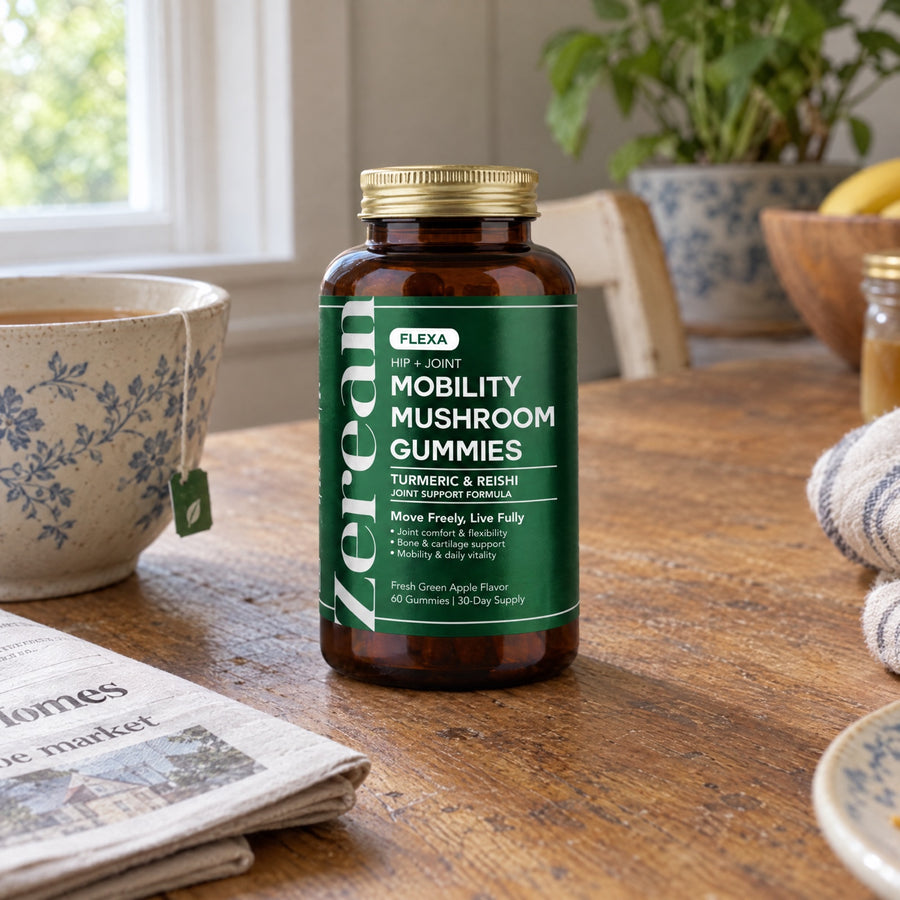
Your first bottle, 46% off
First order only, one per customer. Free shipping on orders over $80. Regular price $64.99.
4.8/5 TrustScore · GMP-Certified · Third-Party Tested
90 days. And if you're not moving easier, the next bottle is on us.
You can't feel cartilage rebuild in an afternoon. It's raw material, delivered daily, doing quiet work over weeks — so we're not going to ask you to judge it overnight. You get a full 90 days.
And if you finish the bottle and you're honestly not moving easier, get in touch and we'll send you another one free, so you've got the runway to actually feel the difference. No hoops. No "how much is left in it".
Questions people ask before their first bottle
No, and be careful with anyone who says their product does. The regeneration research mentioned above is early-stage laboratory work, not something you can buy. Flexa supplies the raw material cartilage is built from, delivered where the tissue can actually take it in. That's a different and much smaller claim.
No. What you see is what you're charged, once. If you'd like it sent automatically you can choose that at checkout, and change or stop it whenever you like.
Almost certainly your old bottle had no absorption partner and no way into the joint fluid — so the ingredients were fine and they never arrived. That's the whole reason Reishi is in this formula.
It isn't a painkiller and we won't pretend otherwise. It supplies the material cartilage is built from. That's a slower, different thing than muting a signal.
Talk to your GP or pharmacist before adding anything, especially if you're on blood thinners or managing a condition. We'd rather you asked.
Finish the bottle and tell us. We'll send you another one free so you get the full 90 days.
Customer Reviews